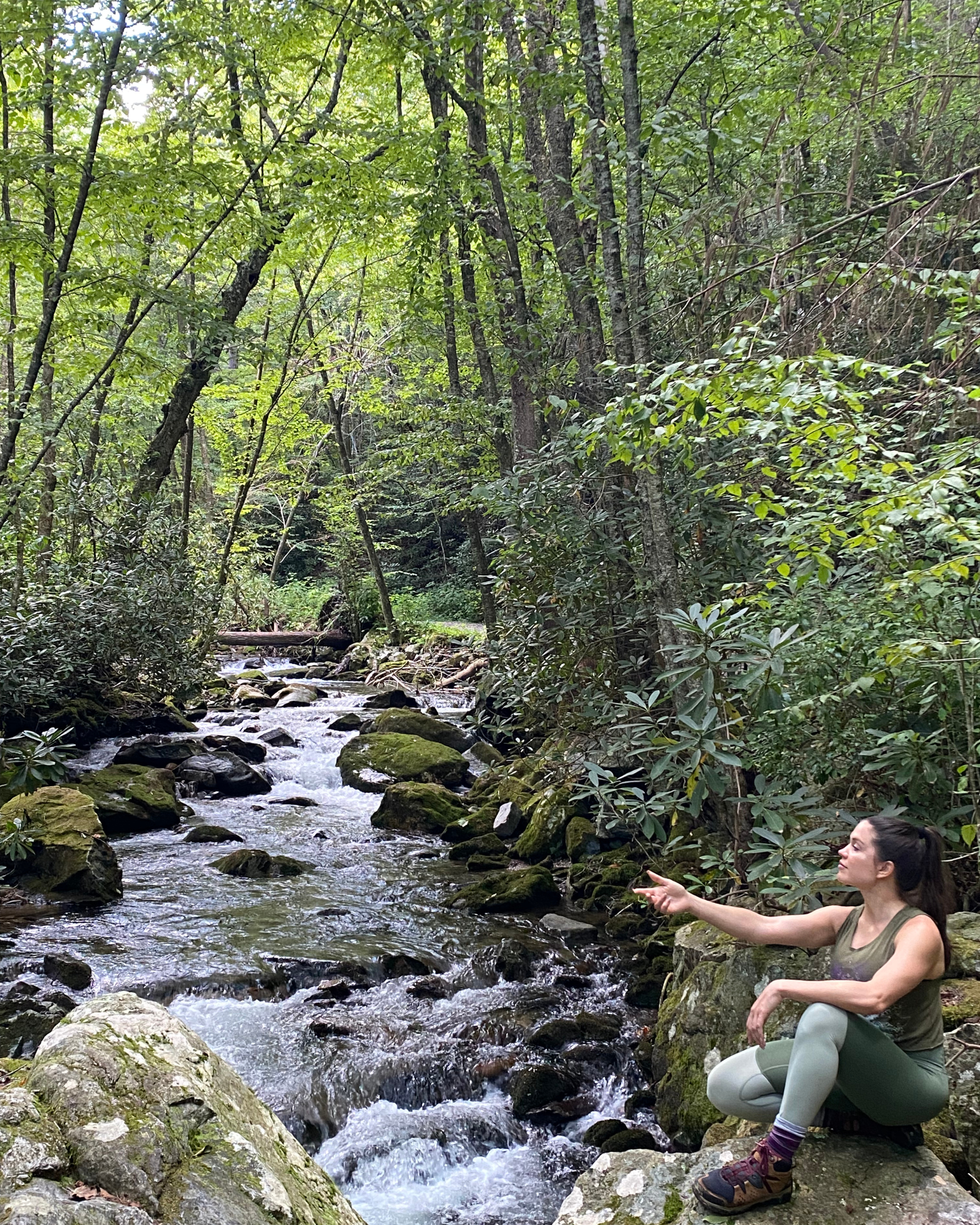
I opened my front door this morning and was greeted by a delicious cool breeze. A few weeks into October, and the weather finally remembered how to behave like autumn. Crispy brown and orange leaves trailed the driveway, and I had wistful thoughts of pulling out chunky sweaters and leather boots from storage. Autumn is a time of necessary shedding. The fruit releases from the stem for harvest, and the trees loosen their leaves in preparation for what’s to come: winter, yes, but for the purpose of this essay—the fertile void of internal incubation.
The natural world’s cycle mirrors the human creative cycle. We work, we reap, we rest, repeat. The tree must drop its leaves or else it would not survive the dead weight of them through the winter. The shedding and stillness are essential. Whether such change is forced upon us by circumstance or chosen consciously, Carl Jung conceptualized it as the nigredo— a term borrowed from alchemy, a mysterious and foundational stage of transformation. The nigredo is a blackening of matter, a psychological winter in which what once was begins to dissolve so that something truer might take root. It is not destruction for its own sake, but composting—the psyche’s way of preparing the soil.
In an age of constant distraction, imagined productivity, and anxious motion, it’s hard to imagine a void as fertile. “Fertile” and “void” seem like opposites, like two ends of a spectrum. If I’m not doing, then what am I? It’s the shadow of our Cartesian inheritance—the belief that I am only real insofar as I’m producing, proving, performing. But stillness asks something deeper of us. It threatens the illusion that movement equals meaning.
Stillness can be terrifying for two reasons. First, when we slow down, we must face ourselves. It’s no wonder anxiety flares so ferociously in the small hours of the night; silence amplifies the voice within. The Self summons, eventually, no matter how long we try to outrun it. Second, in stillness, the outer validation of movement disappears. Without doing, we are left only with being—and that kind of exposure can feel like a reckoning.
I realized recently that I had gone over a year without publishing a reflection on my blog. I somehow had managed to swat away my feelings of concern, judgment, and despair until that point- I suppose through sheer avoidance. When I finally turned toward those feelings, I wanted to scold myself for not “showing up.” How dare I put off something as essential and core to who I am as writing?
But then again—what good does that kind of self-talk ever do? The inner critic rarely motivates the way we intend. It merely stifles. And yet here I am, writing again. My creative pulse never disappeared; it had only gone underground. Seeds lying beneath the dark soil of winter are not dead. They are gestating, quietly working in unseen ways. There is always activity in dormancy.
Perhaps this is the rhythm the earth has been modeling to us all along—that there is no endless summer of bloom. Even the most radiant gardens are beholden to the hush of winter. Beneath frozen soil, roots stretch deeper. Energy retracts inward, gathering itself for the next eruption of life. What if we trusted that our own retreats, too, were part of this same intelligence? That our pauses were not failures, but preparations?
Maybe the void is not empty at all. Maybe it’s the quiet inhale before creation— the space between breaths where life resets itself. To rest, to go still, to wait—is to collaborate with what is unseen. The quiet is not an ending, but the beginning of a deeper becoming.
Reflection Prompt
When have you experienced a “fertile void” in your own life—a period that felt empty at the time but later revealed its quiet purpose?
(I’d love to hear from you in the comments. Sharing stories of what stillness has taught us helps reframe it not as absence, but as initiation.)